
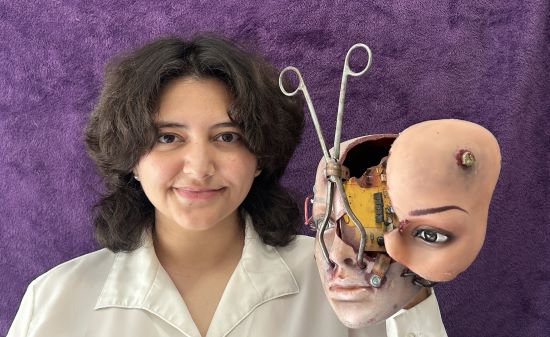
Not one, but two of Lone Star College-CyFair student Juliette Stinson’s art pieces were selected for inclusion in the Texas Association of Schools of Art (TASA) ARTOVATION Student Show 2026.
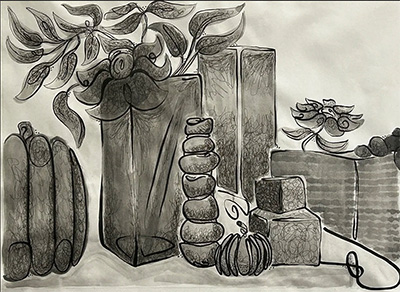
One of Stinson’s pieces chosen was an ink drawing of a still life class assignment, which she added creative interpretation and personal touches to and titled “The Clutter”. The second was “The Dissection of Identity” made from found objects, including a mannequin head and pieces of a discarded computer, and was inspired by the idea of individuality and the constant process of self-discovery.
TASA’s online art and design competition open to all students in 2-year and 4-year colleges and universities was a meaningful experience for Stinson. She said having her artwork featured alongside nearly 500 undergraduate students statewide was not by chance.
 “I worked for it … and at least one judge looked at my work and believed it belonged there,” said Stinson, who is dyslexic and adds that art became her way to be understood and communicate when words weren’t enough. “I never thought I’d have the chance to do something like this (competitive virtual exhibition), but I did, and that alone feels amazing.”
The TASA experience also had professional and personal benefits. She said the state level recognition adds credibility to her work and helps present her art as serious and intentional. Including it on her résumé and portfolio will be impactful when applying for universities, art programs or jobs.
“Personally, this opportunity meant a lot because it motivates me to keep creating and growing as an artist. Recognition like this gives me the confidence to keep pursuing art and to invest more time and energy into future projects. It reassures me that what I’m doing matters and encourages me to continue building something that I genuinely care about.”
In LSC-CyFair’s Art Department program, Stinson said instructors provide a balance of guidance and creative freedom, which allows for exploration of one’s own style without fear of making mistakes, because they genuinely want students to succeed.
“They take the time to give thoughtful feedback; they recognize your potential even when you don’t see it yourself; they create an environment where you feel supported but also pushed to do better; and they make the classroom feel like a place where you belong.”
Art has always been an important part of who Stinson is, so she plans to simultaneously pursue her passion for art while working toward graduating this fall with a degree in Criminal Justice and a career goal of becoming a lawyer, possibly focusing on humanitarian or civil rights work.