
Gen Ed/Core Assessment
The Office of Institutional Assessment supports educational programs in assessing learning outcomes at the course level, program level, and institutional level for continuous improvement.
Interested in Learning More about the Lone Star College Core Assessment Cycle?
Core Assessment: From Annual to Bi-Annual Cycle
Lone Star College's bi-annual cycle allows faculty members to assess selected General Education Competencies/Core Objectives for one year and then implement changes based on the assessment results for the subsequent year, thus providing more time for faculty to implement changes and engage in the "Review and Revise" phase of the assessment process and methodologies.
Specifically, in AY 2026-27, sampled faculty members will assess Personal Responsibility, Social Responsibility, Empirical & Quantitative Skills, and Teamwork, whereas the other three Core Objectives will not be assessed, but rather be involved in the "Review and Revise" phase (implementing changes recommended from the previous year while revising the assessment assignments and rubrics based on faculty feedback).
AY 2025-26 Core Assessment Support Documents:
1. AY 2026-2027 Core Assessment: Faculty Selected for Collecting Student Artifacts
2.Core Assessment Committee Members' Contact List
3. LSC Core Assessment Rubrics
Core Assessment Reports:
1. 2025-2026 Core Assessment Report OVC, WC, CT
2. 2024-2025 Core Assessment Report EQS, PR, SR, TW
3. 2023-2024 Core Assessment Report OVC, WC, CT
4. 2022-2023 Core Assessment Report EQS, PR, SR,TW
5. 2021-2022 Core Assessment Report OVC, WC, CT
6. 2020-2021 Core Assessment Report
LSC Core Assessment (A Brief Guide)
I. LSC Core Assessment Cycle:
Lone Star College (LSC) follows a five-stage assessment process to gauge LSC students' mastery of the 7 Gen Ed competencies/Core Objectives. See the following chart for more details:
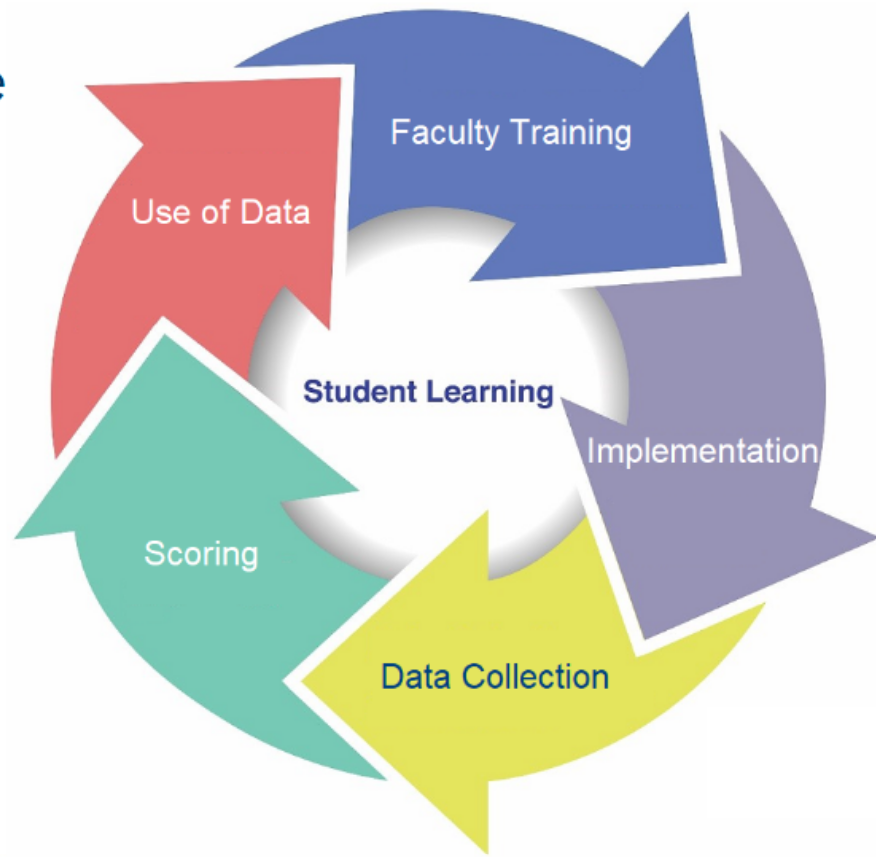
1 Faculty Training: In the fall, online training is provided to approximately 100 faculty randomly chosen from across the institution. The training reviews the core assessment process, the common rubric used to assess core objective learning, how the instructor can align his/her individual assignments to the rubric, and how to submit the students’ work as a student artifact of learning.
2 Implementation: Faculty then give their core assignment to students to complete and implement any recommendations for improved learning they wish.
3 Data Collection: At the end of the fall term, faculty submit their students’ work to be “scored.”
4 Scoring: In the Spring, volunteer faculty participate a “Scoring Day” – assessing student artifacts using the common rubrics. Training concerning the overall core assessment process and rubrics is provided at the beginning of the session which also serves to calibrate scores. Each artifact is scored by two Scorers to determine students’ level of learning of the Core Objective. Data are collected and published in core assessment results reports by the Office of Institutional Assessment (OIA).
5 Use of Data: Core Assessment results and a feedback survey are shared with faculty who participated in the assessment activities, either as a faculty submitting artifacts or as a Scorer. These faculty are then prompted to analyze the data, identify areas of potential improvement, and provide recommendations that other faculty can use in order to improve student learning of the core objectives. This information is collected and reviewed by the core assessment committee (there is a subcommittee for each core objective with a representative from each campus). Finalized recommendations are published on the GenEd website and shared with faculty and leadership, and imbedded within the faculty training for the next cycle of assessment.
II. Core Assessment Resources:
Please utilize the following resources to support your Core Assessment efforts:
Frequently Asked Questions about the Core Assessment -
2. Rubrics, Assignment alignment checklists, Assignment examples, and Recommendations by Core Objectives:
Communication (Oral): Rubric, > Assignment Example
- Improvement Recommendations for Implementation in 2018-19
- Improvement Recommendations for Implementation in 2019-20
- Improvement Recommendations for Improvement in 2020-21
- Improvement Recommendations for Improvement in 2024-25
- Improvement Recommendations for Improvement in 2025-26
Communication (Written): Rubric,> Assignment Example
- Improvement Recommendations for Implementation in 2018-19
- Improvement Recommendations for Implementation in 2019-20
- Improvement Recommendations for Implementation in 2024-25
- Improvement Recommendations for Implementation in 2025-26
Critical Thinking: Rubric, Assignment alignment checklist > Assignment Example
- Improvement Recommendations for Implementation in 2018-19
- Improvement Recommendations for Implementations in 2019-20
- Improvement Recommendations for Implementation in 2024-25
- Improvement Recommendations for Implementations in 2025-26
Empirical and Quantitative Skills: Rubric,Assignment alignment checklist > Assignment Example
- Improvement Recommendations for Implementation in 2018-19
- Improvement Recommendations for Implementation in 2019-20
- Improvement Recommendations for Implementation in 2025-2026
- Improvement Recommendations for Implementation in 2026-2027
Personal Responsibility: Rubric, Assignment alignment checklist > Assignment Example
- Improvement Recommendations for Implementation in 2018-19
- Improvement Recommendations for Implementation in 2019-20
- Improvement Recommendations for Implementation in 2025-2026
- Improvement Recommendation for Implementation in 2026-2027
Social Responsibility: Rubric, Assignment alignment checklist > Assignment Example
- Improvement Recommendation for Implementation in 2018-19
- Improvement Recommendation for Implementation in 2019-20
- Improvement Recommendation for Implementation in 2023-2025
- Improvement Recommendation for Implementation in 2025-2026
Teamwork: Rubric, Assignment alignment checklist > Assignment Example
- Improvement Recommendation for Implementation in 2018-19
- Improvement Recommendation for Implementation in 2019-20
- Improvement Recommendation for Implementation in 2025-2026
- Improvement Recommendation for Implementation in 2026-27
III. Directions on How to Submit Student Artifacts:
After you have collected student artifacts for Core Assessment, you can submit them to your campus Core Assessment email. Click on the following link to access specific instructions on how to prepare the submission files and what the campus email addresses are:
Directions on How to Submit Student Artifacts
IV. Campus Contact for Core Assessment:
Each campus has a Core Assessment faculty representative to support faculty's Core assessment efforts. These faculty representatives are also in charge of their campuses' Core Assessment emails. Please refer to the following chart for the campus Core Assessment emails:
| LSC Core Assessment Email by Campus | |
| Campus | Core Assessment Emails |
| CF | CF-CoreAssessment@lonestar.edu |
| HN | HN-CoreAssessment@lonestar.edu |
| KW | KW-CoreAssessment@lonestar.edu |
| MC | MC-CoreAssessment@lonestar.edu |
| NH | NH-CoreAssessment@lonestar.edu |
| OL | ol-coreassessment@lonestar.edu |
| UP | UP-CoreAssessment@lonestar.edu |
| TC | TC-CoreAssessment@lonestar.edu |