
LSC-Montgomery Medical Radiologic Technology Department
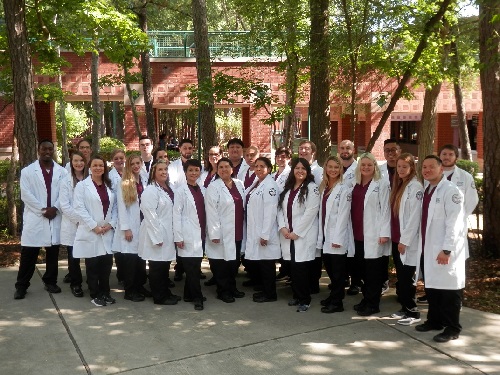
Program Overview
Lone Star College - Montgomery offers a two-year Associate of Applied Science degree program in Medical Radiologic Technology. A prospective student must be 18 years or older to be admitted and enroll in the professional phase of the MRT program. Enrolled students receive classroom instructions (didactic education) at the college and clinical education experiences at affiliated hospitals and clinics. Radiography education is a competency-based education, which exposes the student to the underlying principles of radiologic sciences and varieties of hands-on learning experiences that enable the student to acquire knowledge, develop and enhance imaging skills, and successfully complete required clinical competencies and outcomes.
Student learning outcomes in didactic education are assessed using combinations of unit tests, quizzes, research projects, term papers, classroom discussions, presentations, and final comprehensive examinations. Clinical education learning outcomes and skill development are assessed by way of clinical competency demonstrations and testing in program laboratories and at affiliated clinical education sites. Students receive letter grades in both didactic and clinical courses at the end of each semester, and they are required to achieve and maintain a grade of “C” (75%) or better in each course, in order to continue in the program and graduate. Program graduates are effectively prepared to pass the American Registry of Radiologic Technologists’ (ARRT) national certification/ credentialing examination at first attempt.
Program Accreditation Standards
The Lone Star College – Montgomery Radiography Program is accredited by the
Joint Review Committee on Education in Radiologic Technology
20 North Wacker Drive, Suite 2850, Chicago, IL 60606-3182
Phone: 312-704-5300; Email: mail@jrcert.org
LSC-Montgomery JRCERT Program #0496
Most Recent Site Visit: 02/2025
The program's current accreditation award is 8 years.
General program accreditation information and the current accreditation award letter can be found at https://www.jrcert.org/programs/lone-star-college-montgomery/
The continuing accreditation status of the program was considered at the June 9, 2025, meeting of the Joint Review Committee on Education in Radiologic Technology. The program was evaluated according to the Standards for an Accredited Educational Program in Radiography (2021). The program documents compliance with all relevant Standards; therefore, the JRCERT awards: ACCREDITATION FOR A PERIOD OF EIGHT YEARS. The maximum duration that may be awarded by the Joint Review Committee on Education in Radiologic Technology in this category is eight years.
An interim report will be required. The projected date for submission of the interim report is the First Quarter of 2029. Based on the interim report, the JRCERT will determine if the accreditation award of eight years will be maintained or reduced, and the continuing accreditation process expedited. If the accreditation award is maintained, the next site visit is tentatively scheduled for the First Quarter of 2033.
Student complaints regarding allegations of Program non-compliance with JRCERT Standards will be addressed according to the published Program and LSCS appeal processes. The Program will maintain all such complaints with their resolution in accordance with the United States Department of Education (USDE) regulations. For additional information, contact the JRCERT at 312.704.5300 or www.jrcert.org
Mission Statement
The mission of Lone Star College Montgomery, Medical Radiologic Technology Programs, is to provide a comprehensive education of structured learning experiences and to assist in meeting the community’s need for medical imaging professionals. The program’s curriculum combines didactic and clinical education experiences to enable the student to acquire knowledge; develop medical imaging skills; professional values; and the desire for life-long learning. Graduates of the programs are effectively prepared for entry-level positions in the medical radiologic technology profession.
Program Goals and Student Learning Outcomes
Goal #1: Graduate entry-level Medical Radiologic Technologists, who are effectively prepared to pass the ARRT National Certification/Credentialing Examination on first attempt
- MRT students will complete the program requirements in 24 months and graduate with an AAS degree.
- Final year MRT students will demonstrate readiness to pass the ARRT credentialing exam and also pass the actual ARRT examination on first attempt, within 6 months postgraduation.
Goal #2: Develop clinical competencies in program students
- MRT students will demonstrate competencies in hands-on radiographic procedures/ positioning, in the selection/application of exposure technique factors, and in the practice of radiation protection.
- MRT students will demonstrate acceptable professionalism and work ethics at affiliated clinical education sites.
Goal #3: Develop effective communication skills in program students
- MRT students will demonstrate proficiency in scientific term paper written and oral communications
- MRT students will demonstrate effective communication skills in online group forum discussions.
Goal 4: Develop critical thinking and problem-solving skills in program students
- MRT students will critically analyze radiographic images and determine diagnostic quality
- MRT students will critically analyze a radiation protection issue and effectively demonstrate problem solving skills.
Program Effectiveness and Outcomes Assessment Data
December 2020 - December 2024 LSC-Montgomery MRT Program Effectiveness and Outcomes Data
“If you are considering a career in radiography, you will want to choose an accredited educational program to prepare you for your career. Successful completion of a JRCERT-accredited program assures that you will be provided with the knowledge, skills, and professional values required for career success. The JRCERT monitors performance measures of programs and makes this information available to the public”. Click on the link below to view Lone Star College – Montgomery Accredited Program Details.
https://www.jrcert.org/programs/lone-star-college-montgomery/
Notice to Students Regarding Licensing and Immunization
Effective September 1st 2017, HB 1508 amends the Texas Occupations Code Section 53 that requires education providers to notify you a potential or enrolled student that a criminal history may make you ineligible for an occupational license upon program completion.
Health Occupations Immunization Informed Consent
Consequences of Criminal Conviction
LSC-Montgomery MRT Program Information
Entry Requirements and Application Process
Other MRT Related Information
If you have questions about the MRT program, please reach out to
MC-rad@lonestar.edu.